
Nested Resources
Set up parent/child relationships so /companies/:id/nested_properties works automatically.
Goal
Company has_many :properties, and you want:
- A "Properties" tab on the Company show page.
- A nested URL
/companies/123/nested_propertiesfor the company's properties. - Forms that auto-fill the parent (no manual hidden field).
- Queries scoped to the parent (sibling companies' properties invisible).
All of this happens with no manual route wiring; Plutonium generates it from the association.
Steps
1. Scaffold parent and child
rails g pu:res:scaffold Company name:string --dest=main_app
rails g pu:res:scaffold Property company:belongs_to name:string --dest=main_app
rails db:prepare
2. Connect both to the portal
rails g pu:res:conn Company Property --dest=admin_portalPlutonium reads the has_many :properties association on Company and registers nested routes for Property automatically.
3. (Optional) Expose the relationship on the Company show page
class CompanyPolicy < ResourcePolicy
  def permitted_associations
    %i[properties]
  end
end
This adds a "Properties" tab on the Company show page that loads the nested collection. See Reference › Behavior › Policies › Association permissions.
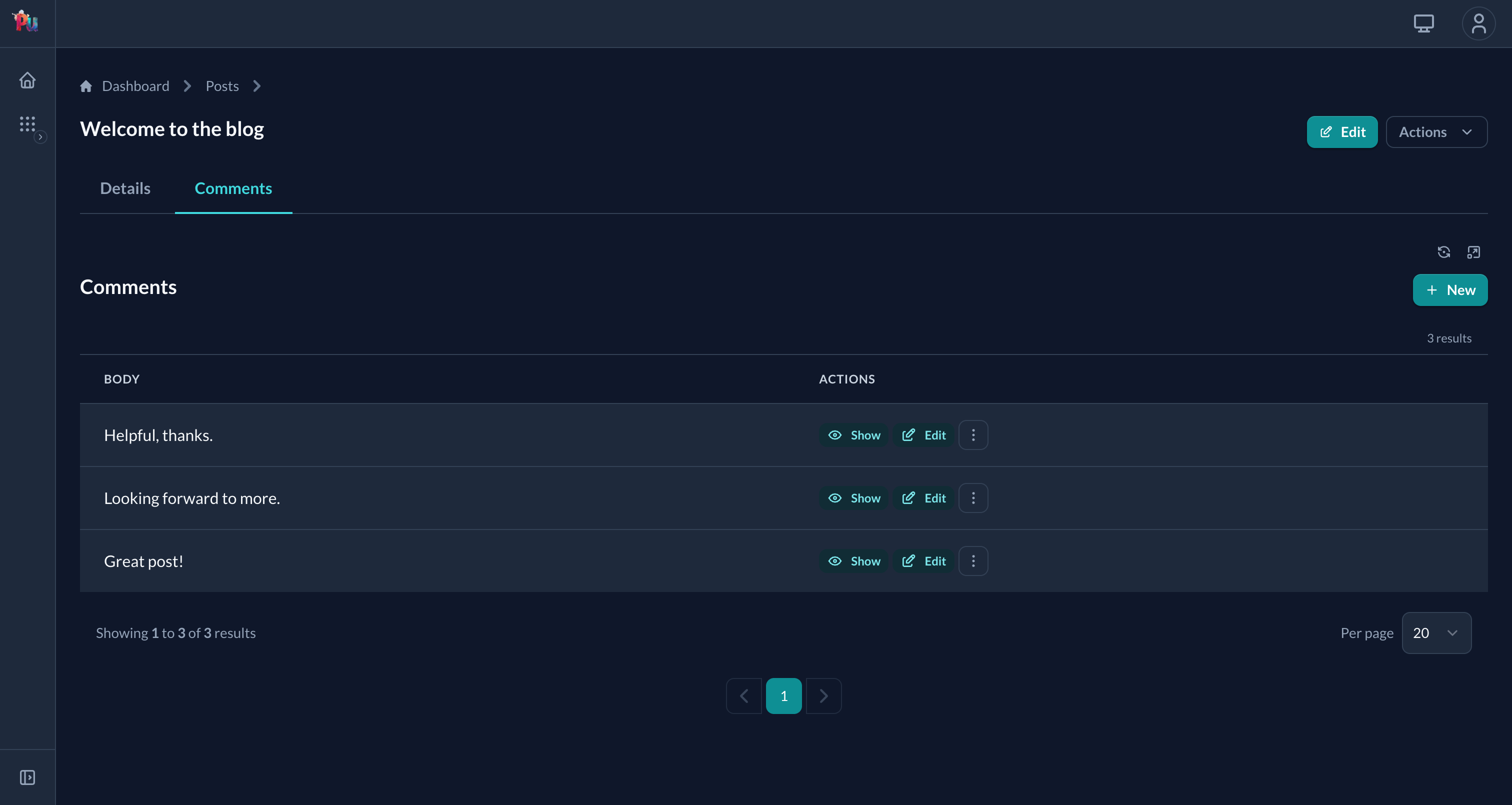
4. Visit the URL
/admin/companies/1/nested_propertiesProperties index, scoped to Company #1. Forms hide the company field (already determined by URL).
Generated routes
Plutonium prefixes nested routes with nested_ so they don't conflict with top-level:
| Route | Purpose |
|---|---|
/companies/:company_id/nested_properties | has_many index |
/companies/:company_id/nested_properties/new | new |
/companies/:company_id/nested_properties/:id | show |
/companies/:company_id/nested_company_profile | has_one show (no :id) |
/companies/:company_id/nested_company_profile/new | has_one new |
has_one associations get singular routes: index redirects to show (or new if no record exists).
Every routable association gets one by default. To draw only some of them:
register_resource ::Company, associations: %i[properties company_profile]Set config.nested_association_routes = :declared to make that the rule, so a resource naming none gets none. See Reference › Tenancy › Nested resources.
What Plutonium does automatically
- Resolves the parent via
current_parent, authorized for:read?. - Scopes queries via the parent association (
company.propertiesforhas_many;where(company_id: ...)forhas_one). - Assigns the parent on create (injected into
resource_params), building the record on the parent's association so a scoped association supplies its defaults. - Hides the parent field in forms and displays.
No hidden fields. No manual scoping.
URL generation
Use resource_url_for with the parent: option:
resource_url_for(Property, parent: company)
# => /admin/companies/123/nested_properties

resource_url_for(property, parent: company)
# => /admin/companies/123/nested_properties/456

resource_url_for(Property, action: :new, parent: company)
resource_url_for(property, action: :edit, parent: company)

# Interactions compose with parent
resource_url_for(property, parent: company, interaction: :archive)
resource_url_for(Property, parent: company, interaction: :bulk_delete, ids: [1, 2])
Common patterns
Show parent on standalone listings
By default, the parent field is hidden in forms/displays (it's in the URL). To show it on the standalone (non-nested) listing:
class PropertiesController < ::ResourceController
  private
  def present_parent? = current_parent.nil?
end
Custom parent resolution (e.g. by slug)
def current_parent
  @current_parent ||= Company.friendly.find(params[:company_id])
end
Compound uniqueness within parent
class Property < ResourceRecord
  belongs_to :company
  validates :code, uniqueness: {scope: :company_id}
end
Without the scope, the same code in different companies would collide.
Custom routes on nested resources
register_resource ::Property do
  member do
    get  :analytics, as: :analytics    # `as:` is REQUIRED
    post :archive,   as: :archive
  end
end
Always pass as:
Without as:, resource_url_for(property, parent: company, action: :analytics) fails: no named route to look up.
Policy authorization context
The child policy automatically receives the parent:
class PropertyPolicy < ResourcePolicy
  # parent              => the Company instance
  # parent_association  => :properties

  def create?
    parent.present? && user.member_of?(parent)
  end
end
The parent is authorized for :read? before current_parent returns; children inherit the parent's access requirements.
Parent scoping vs entity scoping
When a parent is present, parent scoping wins: default_relation_scope scopes via the parent association, NOT entity_scope. The parent was already entity-scoped during its own authorization; double-scoping isn't needed.
In the child policy, just call default_relation_scope: it handles both cases:
relation_scope do |relation|
  default_relation_scope(relation)    # parent when present, entity_scope otherwise
end
See Reference › Tenancy › Nested resources › Parent vs entity scoping.
Nesting limitations
Plutonium supports one level of nesting only:
- ✅
/companies/:company_id/nested_properties(parent → child) - ❌
/companies/:company_id/nested_properties/:property_id/nested_units(grandparent → parent → child)
For deeper hierarchies, use top-level routes plus association tabs on the show page (permitted_associations).
Nested inputs (sub-records inside a parent form)
A different feature with a confusingly similar name. Nested resources (above) give you separate URLs for the child collection. Nested inputs let you edit child records inline inside the parent's form: a single submit creates/updates/deletes them in one go, backed by Rails' accepts_nested_attributes_for.
Use nested inputs when the children are conceptually part of the parent (line items on an order, variants on a product, contact methods on a person) and don't deserve their own page.
Setup
# Model
class Post < ResourceRecord
  has_many :comments
  accepts_nested_attributes_for :comments, allow_destroy: true, reject_if: :all_blank
end

# Definition
class PostDefinition < ResourceDefinition
  nested_input :comments do |definition|
    definition.input :body, as: :text
  end
end

# Policy: list the association name (NOT `comments_attributes`)
class PostPolicy < ResourcePolicy
  def permitted_attributes_for_create
    [:title, :body, :comments]
  end
end
Permit the association, not the strong-params shape
List :comments in permitted_attributes_for_*: Plutonium translates it to comments_attributes: [...] for you. If you write the raw hash, the form renders the field name as a literal label instead of the nested editor.
Result
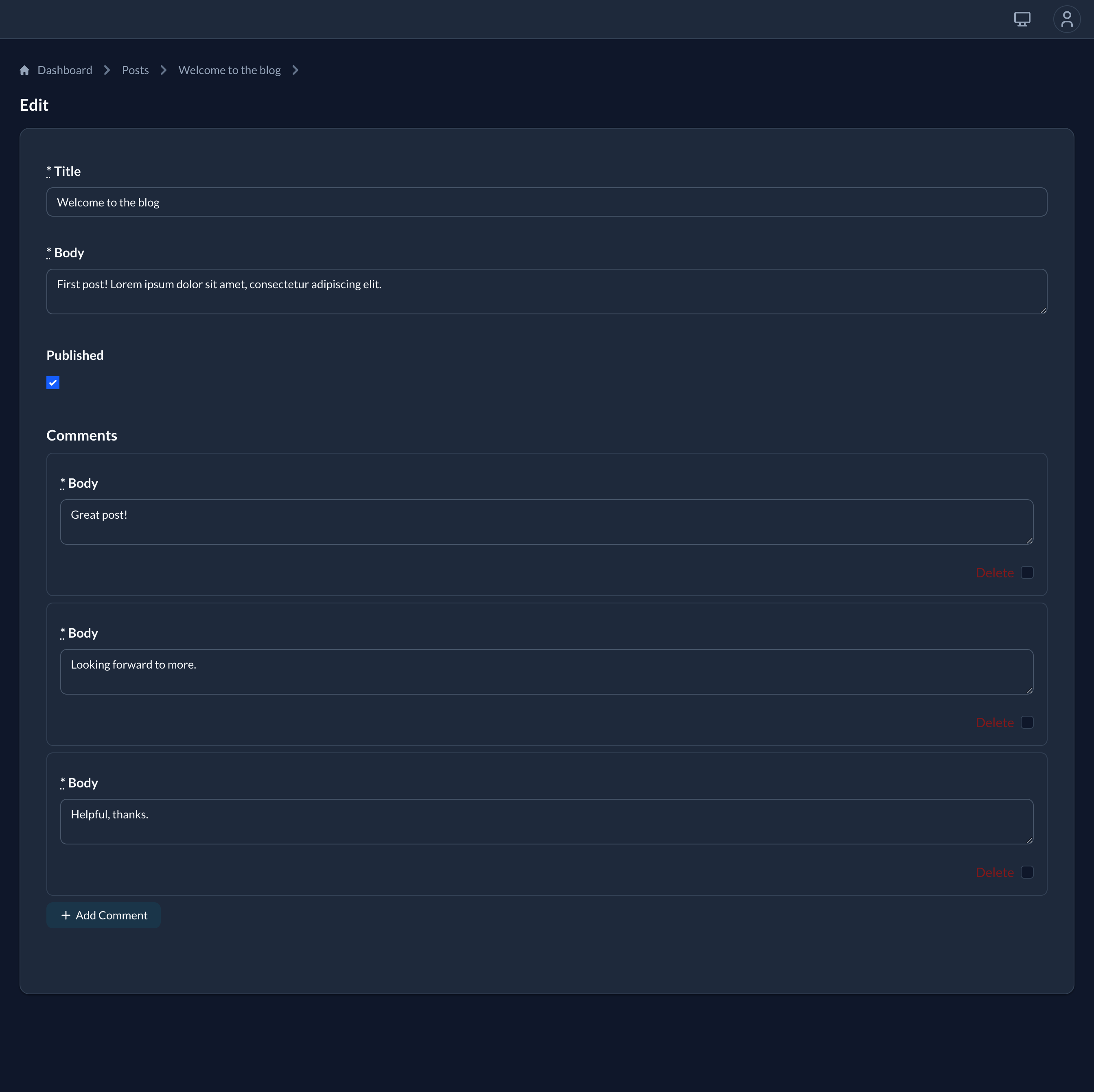
Each existing child renders as its own sub-form. A Delete checkbox appears when allow_destroy: true; the + Add button appends a blank row.
Sourcing fields from an existing definition
If the child already has its own Definition and you want to reuse its inputs:
nested_input :comments, using: CommentDefinition, fields: %i[author body]Limits
nested_input :variants, limit: 5      # cap the number of children
nested_input :profile,  macro: :has_one   # singular sub-form, no Add button
Nested inputs vs nested resources
Nested inputs (nested_input :comments) | Nested resources (this guide's main topic) | |
|---|---|---|
| URL | None, inline in parent form | /posts/:id/nested_comments |
| Submit | One, saves parent + children together | Independent CRUD per child |
| Discoverability | Always visible in parent form | Tab on parent show page (with permitted_associations) |
| Best for | Tightly-owned children (line items, variants) | Children users browse on their own (orders, posts) |
| Backing | accepts_nested_attributes_for | Plutonium's nested controller routing |
You can use both on the same association; they're not mutually exclusive.
Inline + add on the parent form
When a form has an association select (e.g. picking the company on a Property form), the inline + button next to the select opens the parent's :new action. If the parent form is already in a modal, the + opens a stacked secondary modal so the in-progress form isn't lost. See Reference › UI › Forms › Association inputs.
Common issues
- Nested route doesn't exist: both parent AND child must be registered in the same portal (
pu:res:conn). - Parent shows up in the form anyway: check
present_parent?/submit_parent?on the controller. Default is to hide on nested routes. - Multiple
belongs_toto the same parent class (e.g.Match belongs_to :home_team, :away_team): give the parent onehas_manyper side (has_many :home_matches, class_name: "Match", foreign_key: :home_team_id). Each becomes its own nested route, and Plutonium fills in the matchingbelongs_tothroughinverse_ofor the foreign key, so nothing raises.scoped_entity_associationonly matters when the parent class is also the portal's entity; see Reference › Tenancy › Entity scoping. resource_url_forreturns wrong URL for a nested resource: check that custom routes useas:.
Related
- Reference › Tenancy › Nested resources: full surface
- Reference › Behavior › Controllers:
current_parent, presentation hooks - Reference › Behavior › Policies:
permitted_associations - Multi-tenancy: how entity scoping interacts with parent scoping
- Adding resources: basic resource setup