
Async Interactions
Experimental
Async interactions are experimental: the DSL and behavior may change in a future release.
For the task-oriented walkthrough (declaring the action, its policy, and where it appears), start with the Custom actions guide. This page is the reference.
async turns an interaction from "does the work inline" into "persists a run, enqueues it, and redirects to it."
Reach for it once the work stops being something a user can reasonably wait on: archiving ten thousand records, generating a report, calling a third party that takes its time. The run outlives the request, gets a progress page for free, and stays queryable after the fact.
🚨 Critical
- Opt-in and migrated.
config.async_interactions.enabled = true+rails db:migrate(off by default). asyncreplacesexecuteentirely. The interaction still validates, authorizes and renders its form exactly as before; only what happens on submit changes.- Permissions are re-derived at perform time, never replayed from dispatch. A run created a job, not a snapshot of "what the initiator could do then." See Authorization.
- The run itself is a resource. Register it once per portal (
rails g pu:async_interactions:install --dest=your_portal); its show page IS its progress page. - A stalled run does not silently replay.
pu:async_interactions:installschedulesAsync::ReapJobwhen Solid Queue is in the bundle; on any other scheduler you must add it yourself, or a crash mid-batch leaves the row"running"forever. See Stalled runs.
Enabling
# config/initializers/plutonium.rb
Plutonium.configure do |config|
  config.async_interactions.enabled = true
  config.async_interactions.queue = :default        # ActiveJob queue for run jobs
  config.async_interactions.stall_after = 1.hour     # see Stalled runs, below
  config.async_interactions.max_rejections = 100     # pre_check problems stored per run
  config.async_interactions.recent_runs_window = 10.minutes  # finished runs stay in your banner this long
endrails db:migrate # creates plutonium_async_runsThe flag gates the migration, not just the behaviour: while it is off the runs migration path is never registered, so the table does not exist. A async interaction that runs anyway raises Plutonium::Interaction::Concerns::Dispatchable::NotEnabledError naming the flag, rather than a raw "no such table" from inside ActiveRecord.
Declaring the work
async takes a block, and the block is the run's class body. Define perform_on(record) for targeted work (bulk/record actions, one call per target) or perform for opaque work (resource actions with no subject):
class Blogging::ArchivePosts < ResourceInteraction
  presents label: "Archive", icon: Phlex::TablerIcons::Archive
  attribute :resources          # bulk: perform_on runs once per record
  attribute :reason, :string

  async do
    on_failure :continue        # :halt (default) | :continue | :transactional

    def perform_on(post)
      post.archive!(reason: options["reason"])
    end
  end
end
One class. There is no second file, and no name to invent for the run.
Why the block declares perform_on rather than executing
The block is not the body of #execute. The work happens later, in a job, in a process with no controller, no request and no view_context, so it cannot be a closure over anything in the interaction, which is the same reason the row records the initiator and tenant instead of serialising them. So the block declares a Plutonium::Interaction::Async::Run subclass with exactly the API a standalone run has, and the validated attributes arrive through options.
def opens a fresh scope, so those method bodies cannot accidentally capture the interaction's locals.
The generated class is named <Interaction>::Run rather than left anonymous, because the class name is persisted in the run's type column and constantized in another process. An anonymous class would write a row nothing could read back.
on_failure | Behavior when a target raises |
|---|---|
:halt (default) | Stops at the first failure; the run ends "failed", targets after the failure point are never attempted |
:continue | Records the failure, keeps going; the run ends "completed" (see Outcome vs state for why that's not the same as a clean success) |
:transactional | Wraps the whole batch in one DB transaction; any failure rolls back everything applied so far |
Attributes reach the run through options
Everything the interaction validated, except the targets, is written to the run's options and read back in the job:
attribute :reason, :string
async do
  def perform_on(post) = post.archive!(reason: options["reason"])
end
options is a JSON column, so dispatch writes it through ActiveJob::Arguments. Primitives are stored verbatim (a String stays a String in the column) and only values needing one get a serializer envelope, so a Date arrives as a Date and a BigDecimal as a BigDecimal rather than as strings. Hosts can register their own serializers.
An attribute that can't be carried at all is refused at dispatch, naming the interaction, rather than being written to a row whose work then fails deep in a job.
Files
A file can't ride the options column: JSON has no files, and the request's tempfile is deleted on the way out. So an uploaded file is staged to its backend's cache at dispatch and carried as the token: options["import_file"] is that token, a String.
Use attachment to read it back:
class Catalog::ImportProducts < ResourceInteraction
  attribute :import_file

  async do
    def perform
      attachment(:import_file).open do |file|
        CSV.foreach(file, headers: true) { |row| Catalog::Product.create!(row.to_h) }
      end
    end
  end
end
attachment(:key) returns one, attachments(:key) all of them for a multiple-file attribute, each exposing filename, content_type, url, open and download. Reviving reaches storage, so it is not folded into options: the progress page reads options on every poll and has no need of the file.
Per-field backend and uploader
backend: and uploader: are read off the attribute's own input declaration, the same options in the same place a wizard step reads them from:
attribute :import_file
input :import_file, as: :uppy, uploader: Catalog::ImportUploader
The uploader's Attacher.validate rules run when the interaction validates, so a file that breaks them fails the form: the submitter sees a field error and nothing is dispatched. Without that the interaction would validate clean, dispatch, and the author's validate_max_size would surface as a run failure on a page the submitter has already left. A no-op for ActiveStorage fields and for uploaders declaring no rules.
Validating means staging first, since Shrine validates an assigned cached file, so an upload that fails validation has still been written to the cache, and is reaped by the backend's own unattached-cache cleanup. Wizards make the same trade on every step submit.
Where no backend: is declared: config.async_interactions.attachment_backend, then config.attachment_backend, then auto-detection (active_shrine loaded → Shrine, else ActiveStorage). Same layering wizards use.
Checking input before processing
Validations on the interaction run in the request, so they suit cheap checks (an uploader's size and type rules already fail the form there). A check too slow for a request, like reading every row of a large file, goes in the run's pre_check. It runs in the job, before any work, and refuses the input with reject:
require "csv"

class ImportTasks < ResourceInteraction
  attribute :import_file
  input :import_file, as: :file

  async do
    def pre_check
      each_row do |row, line|
        reject "line #{line}: title is missing" if row["title"].blank?
      end
    rescue CSV::MalformedCSVError => e
      reject "the file is not valid CSV: #{e.message}"
    end

    # One transaction: an opaque run restarts from scratch after a reap, so a
    # partial import would otherwise be imported twice.
    def perform
      Task.transaction { each_row { |row, _line| Task.create!(title: row["title"]) } }
    end

    private

    # Read whole, as UTF-8 without Excel's byte-order mark: the stored file
    # comes back as binary, and a BOM would become part of the first header.
    def each_row
      text = attachment(:import_file).download.force_encoding(Encoding::UTF_8).delete_prefix("\uFEFF")
      CSV.parse(text, headers: true).each.with_index(2) do |row, line|
        yield row, line unless row.fields.all?(&:blank?)
      end
    end
  end
end
Rows are numbered from 2 so a message matches the line a spreadsheet shows (the header is line 1), and blank lines are skipped without shifting the numbers after them. The dummy app's ImportTasksInteraction is the full version, with a column check, an empty-file check and status validation.
rejectrecords a problem and returns, so one pass reports every bad row. It does not stop the check:returnexplicitly where nothing after it would make sense, such as a missing column.- If anything was rejected, the run ends
failedwithoutcome == "rejected", the problems listed on its progress page, andperform/perform_onnever runs. The page shows a warning "Rejected" badge and "Nothing was processed". On a:continuerun, targets that had gone missing or lost permission are recorded before the check runs, so they still appear in the list (and count towardprogress_done) even though nothing was performed. - A run with
perform_ondeclarespre_check(records)and receives the resolved, authorized records the loop is about to process. Apre_checkwith the wrong arity fails the run with a message naming the signature it expects. - An exception raised inside
pre_checkfails the run the ordinary way (outcome == "failed"): the check broke, the input was not judged. rejectcalled outsidepre_checkraises.- Only the first
config.async_interactions.max_rejectionsproblems (default 100) are stored, followed by one "and N more problems were found" entry. - The check runs again when a stalled run is resumed, so it must only read. An opaque run always re-checks. A resumed targeted run checks the records it has left, unless an earlier pass already applied a target (that pass's check passed, so it is not repeated).
- A targeted check receives the records as loaded when the run resolved its targets.
perform_ongets each record re-read just before it runs, so a verdict based on record state can be stale by then; re-check anything that must hold at the moment of the work insideperform_on. - A long check must call
heartbeat!(see Long work must say it is alive).
Sharing one run across interactions
Pass a class instead of a block when several interactions do the same kind of work:
class Blogging::ArchivePostsRun < Plutonium::Interaction::Async::Run
  on_failure :continue
  def perform_on(post) = post.archive!
end

class Blogging::ArchivePosts < ResourceInteraction
  async Blogging::ArchivePostsRun
  attribute :resources
end
Passing both a class and a block raises ArgumentError: the block is a run class, so there is nothing to combine.
async must be the only thing that defines #execute on the class. Declaring it on a class that already has its own execute raises ArgumentError at load time (an interaction either executes inline or runs async, never both).
What gets recorded at dispatch
Nothing is passed in explicitly. Everything the run needs is already reachable from the interaction's own state:
- Targets.
attribute :resource/attribute :resources, already narrowed by the controller's policy scope, stored as ids (target_ids) and re-resolved at perform time, never serialized as records. - Initiator + tenant.
current_user/current_scoped_entity, two of the things every Plutonium policy authorizes on. - Nested-route parent.
current_parentandcurrent_nested_association:/orgs/1/posts/5/commentsrecords(Post#5, :comments). Both halves or neither, sincePolicy#default_relation_scoperaises on one alone. This is the third policy input, and it is not optional detail: that method picks one branch, parent or entity, so a nested run without its parent re-derives targets under the tenant where dispatch used the parent, wider than the scope the initiator was shown. It also leaves a host predicate readingparentlooking atnil, which (being declaredoptional: true) answers false rather than raising, refusing every target for a reason that names the predicate instead of the missing context. - The policy actually resolved.
policy_class_name, not an inferred"#{Model}Policy"(a namespaced portal or an STI fallback would make that guess wrong), pluspolicy_action, the predicate dispatch checked (e.g."archive?"). authorization_namespace. The portal's module name, so perform-time policy lookup finds the same narrowed policy dispatch did.
An opaque (untargeted) run records none of the target/policy columns: there's no subject to check, so there's nothing to re-verify.
Authorization is re-derived, not replayed
The job has no controller, no request, no current_user. Async::Context rebuilds the authorization triple from the row and re-checks it from scratch. It does not trust anything the dispatching request already decided:
- The scope check re-runs
Post.associated_with(tenant)style filtering (or, for a nested dispatch, the parent's association). A target that left the tenant or the parent, or was deleted, between dispatch and perform is reportedmissing/unauthorized, never silently skipped. - The predicate check re-asks the policy the same question dispatch asked (
policy_action), per target, immediately beforeperform_on, not once up front. An initiator whose permission was revoked mid-run stops applying to the remaining targets. - A policy mismatch (the class renamed/re-parented/re-namespaced since dispatch) refuses to run at all, rather than silently authorizing under a different policy than the initiator was ever subject to.
- A deleted subject (initiator, tenant or parent) refuses the run. In each case the association nils out, and nil reads as "there was never one": no tenant, or not a nested dispatch. Both of those drop a filter rather than narrowing, so the
*_typecolumn is what tells "carries none" apart from "carries one that is gone".
This is deliberate and asymmetric: a resolution failure always fails closed (refuse / report missing), never open (never "assume permitted").
Outcome vs state
Read run.outcome, not run.state, when displaying or branching on the result. A :continue run that couldn't apply every target still ends with state == "completed", since the author declared partial application acceptable. outcome is what distinguishes that from a clean pass:
run.state    # "completed"
run.outcome  # "completed_with_errors"   (state == "completed" && errors_log.any?)
A run whose pre_check rejected its input reads outcome == "rejected" (its state is "failed", and nothing was processed). A run that failed while working reads "failed".
The progress page, the table's outcome column, and the running banner's entries for finished runs render outcome, never bare state.
Registering the Run resource
Register it once per portal so its show page becomes routable:
rails g pu:async_interactions:install --dest=admin_portal# packages/admin_portal/config/routes.rb
register_resource ::Plutonium::Interaction::Async::Run# packages/admin_portal/app/controllers/admin_portal/async_runs_controller.rb
class AdminPortal::AsyncRunsController < AdminPortal::ResourceController
controller_for ::Plutonium::Interaction::Async::Run
include AdminPortal::Concerns::Controller
endcontroller_for is required: the controller's name doesn't match Run's real, namespaced class, so inference can't find it on its own. No policy/definition files are generated: Plutonium::Interaction::Async::RunPolicy/Async::RunDefinition already resolve automatically (Rails matches Plutonium::Interaction::Async::RunDefinition by the exact class name, and ActionPolicy's own lookup finds AsyncRunPolicy the same way).
If Solid Queue is in the bundle, this also schedules Async::ReapJob in config/recurring.yml (--schedule to override the default every 15 minutes), see Stalled runs and ReapJob. Idempotent, so running the generator against a second portal doesn't duplicate the entry.
A registered run resource gets, for free:
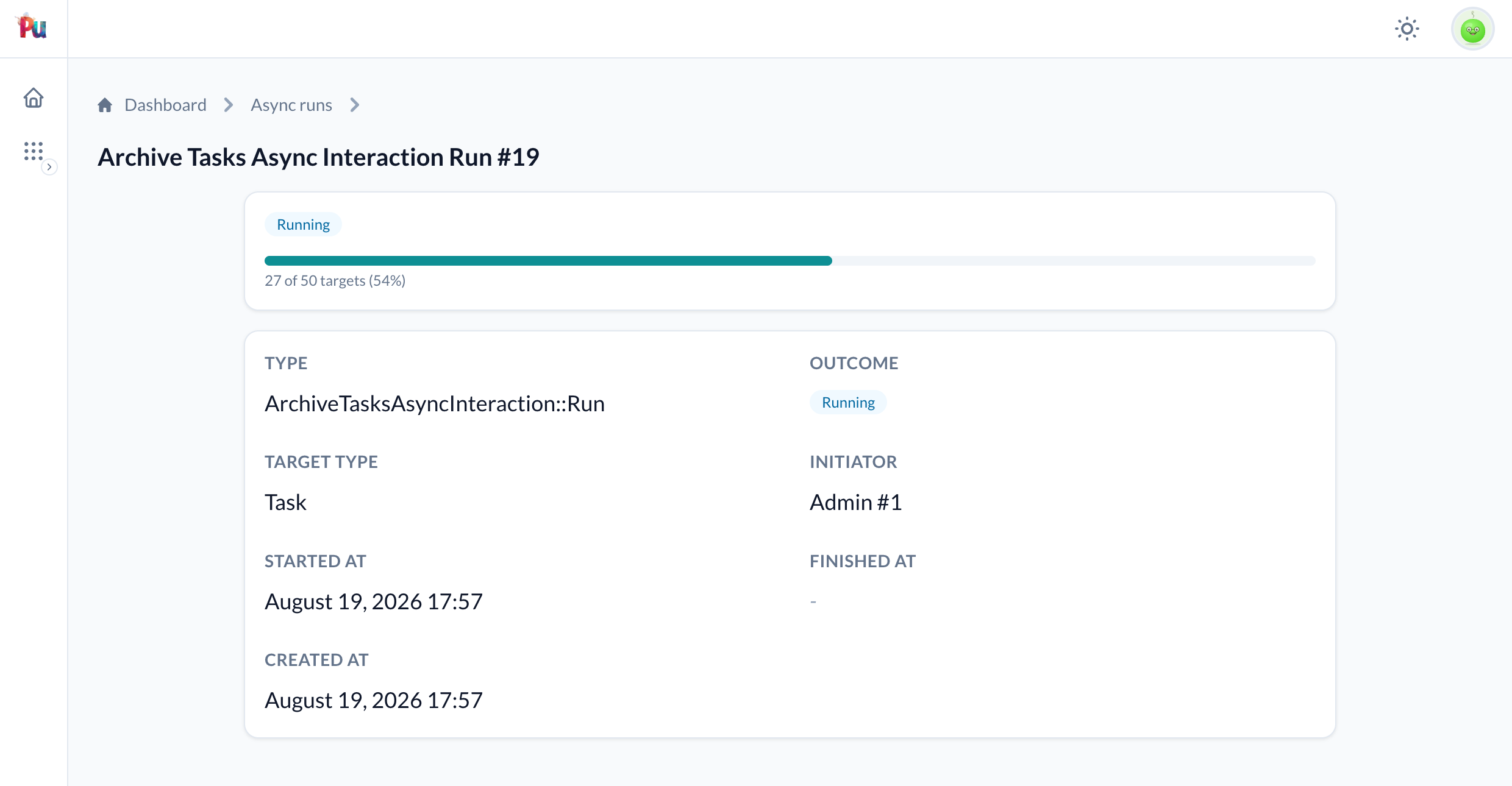
- A progress page. The show page IS the progress page. It self-refreshes via polling (not ActionCable) while
stateispending/running, and stops carrying the poll once the run settles, so a finished run is a static page, not a background request per viewer. - A self-refreshing index. The runs index polls on the same terms as the progress page: one frame around the whole collection, armed only while some run is still working, disarmed the moment none is. One request per interval regardless of page size, and it re-fetches the URL you are on, so filters, sort and page survive the refresh. A frame per row is not an option:
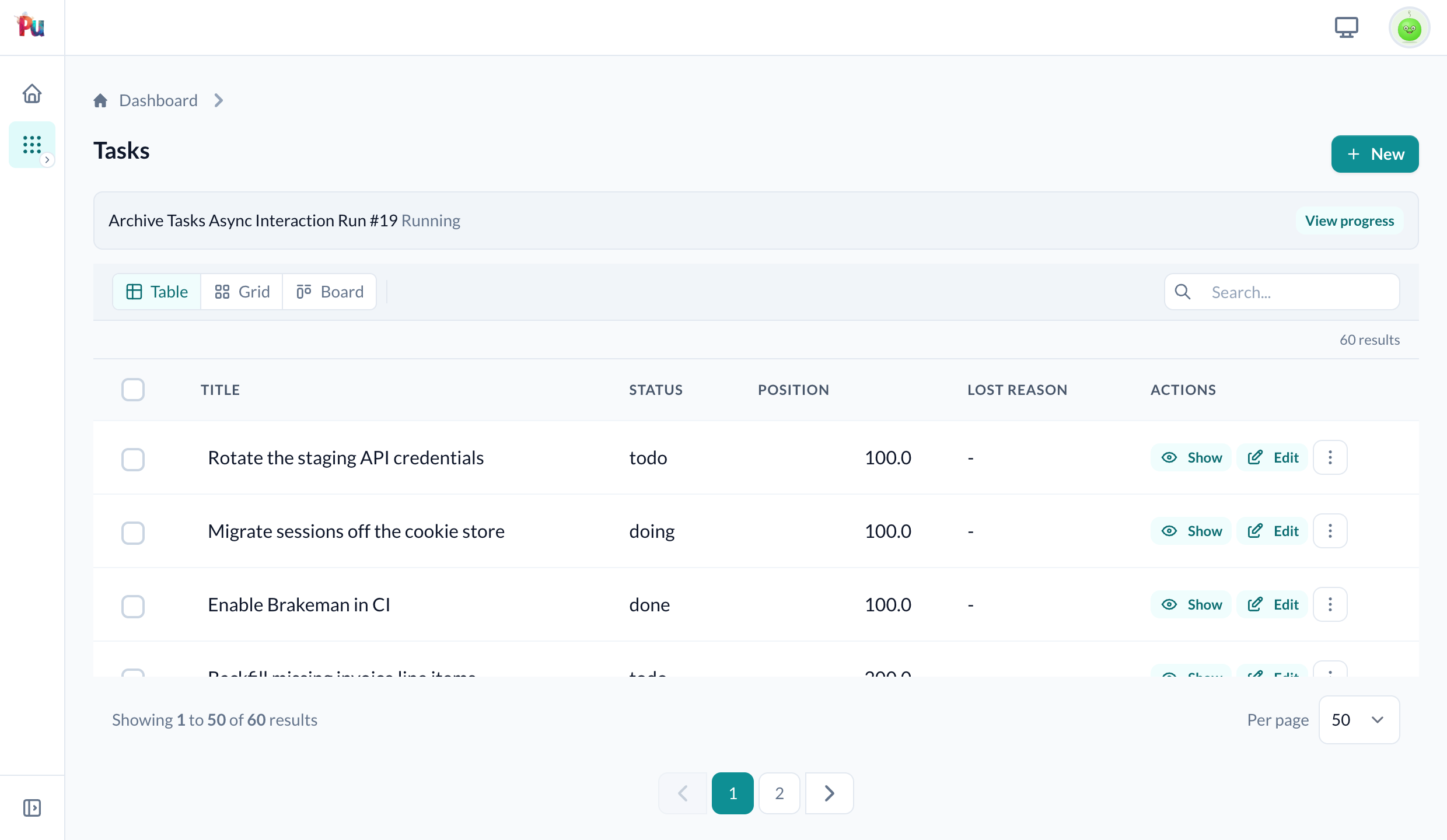
turbo-frameis not in the content model oftr, so the parser hoists it out of the table before Turbo sees it. - A running banner. Any OTHER resource's index page lists runs currently in progress against it, above the collection, so a user who dispatched a bulk action and navigated away can find it again. It also lists the viewer's own runs that finished within
config.async_interactions.recent_runs_window(default 10 minutes, newest first, at most 5), with their outcome and a "View run" link. A dispatch sends the user back to this index, and a short run, or one itspre_checkrejected, has often finished before the page renders. Scoped through the sameauthorized_resource_scopeevery cross-resource read goes through, so a run in another tenant can never surface. If a resource_class is registered in a portal that never registeredRun, the banner is skipped there instead of raising while trying to build a link to a route that doesn't exist. - Tenant scoping. A run's
associated_withscope filters on the tenant it was dispatched in (recorded on the row), not on walking the object graph, since the two polymorphic tenant columns make the generic scope unusable. - Runs named by their interaction. A run declared with an
asyncblock is titled by its interaction's label ("Archive all (async) #19"), frompresents label:or, without one, the class name minus itsInteractionsuffix. A standalone run class passed toasynccan be shared by several interactions, so it is named after its own class. Onlypresents label:reaches the run: alabel:on theactiondeclaration, or aplutonium.actions.<model>.<action>translation, renames the button but not the runs it starts, so put the label on the interaction when both should match. - A humanized target label.
run.target_labelreads the target class throughmodel_name.human("Post", not "Blogging::Post"), falling back to the raw string if that class has since been renamed or removed.
The progress page, mid-run:
And the banner it leaves on the target resource's index while it is still going:
Stalled runs and ReapJob
A worker crash mid-batch (or a job the queue silently drops) leaves a run "running" (or "pending") forever; nothing else ever revisits it on its own. Plutonium::Interaction::Async::ReapJob finds runs with no recorded activity (last_activity_at, falling back to created_at for a run never even picked up) past config.async_interactions.stall_after, and resumes them: resets to "pending" and re-enqueues.
This is safe, not a replay. The executor tracks handled_target_ids (every target already dispositioned, success or failure) and resumes only the remainder, so a target already applied before the interruption is not redone.
rails g pu:async_interactions:install schedules this for you when Solid Queue is in the bundle:
# config/recurring.yml (Solid Queue)
production:
  reap_stalled_async_runs:
    class: Plutonium::Interaction::Async::ReapJob
    schedule: every 15 minutes
Without Solid Queue, or for another scheduler like whenever, add it yourself:
# whenever gem
every 15.minutes do
  runner "Plutonium::Interaction::Async::ReapJob.perform_later"
end
A 15 to 30 minute cadence is reasonable against the default 1-hour stall_after: frequent enough that a stalled run doesn't sit for long, with enough margin that clock jitter doesn't matter.
This is a time heuristic, not a lease
Resuming is based on elapsed time, not a true distributed lock. A run that is merely slow (not dead) and happens to cross stall_after gets resumed too.
What bounds that is lock_version. Both the reaper's resume and the executor's claim bump it, so the worker that is still alive holds a version the row no longer has: its very next write raises ActiveRecord::StaleObjectError, and the executor treats that as "no longer mine": it abandons the pass without marking the run failed and without overwriting the new worker's progress. Two things it deliberately does not do: it cannot interrupt a perform_on already in flight, so one target may be applied twice (once by each side), and it cannot roll back what the superseded worker already committed. Set stall_after well above this app's slowest legitimate run: the fence bounds the damage of a bad value, it does not make one free.
Long work must say it is alive
stall_after is a silence threshold, not a runtime limit. Every write the executor makes refreshes the clock, so a targeted run with quick targets heartbeats once per target for free. Two shapes get nothing, and both are exactly the "long-running task" case:
- Opaque work, and any
pre_check. Between the claim andfinish!the executor writes nothing, because there is nothing to count. Aperformthat outlivesstall_afteris reaped mid-flight and, having nohandled_target_idsto resume from, re-runs from scratch. - A single
perform_onthat outlivesstall_afteron its own.
Call heartbeat! from inside such work:
class Billing::ReissueInvoicesRun < Plutonium::Interaction::Async::Run
  def perform
    invoices.each_slice(500) do |slice|
      reissue(slice)
      heartbeat!        # "still working", resets the stall clock
    end
  end
end
This is deliberately not automatic. A background thread would have to guess a cadence, and would go on reporting a wedged worker as healthy; only the work itself knows it is making progress.
heartbeat! also answers. The write is conditional on this worker still holding the row's lock_version, so one that was superseded inside a long perform raises ActiveRecord::StaleObjectError at its next beat and abandons the pass; for opaque work that is the only place it can find out before finish!. Under :transactional the beat is inside the batch transaction like everything else, so it stays invisible to the reaper until the batch commits.
Queue-level concurrency
On a queue that provides ActiveJob concurrency controls (Solid Queue does, whenever it is in the bundle), the run job also declares a per-run semaphore, and the reaper a global one:
| Job | Key | Limit | Duration |
|---|---|---|---|
Async::Job | the run's id | 1 | config.async_interactions.stall_after |
Async::ReapJob | constant | 1 | Solid Queue's default |
This is declared only when the method exists; Plutonium depends on no queue backend, and nothing above requires one.
It is not a second copy of the claim. claim! can only refuse a duplicate delivery, and only once a worker is already running it, by which point a reaper's resume has re-entered perform_on for one target. The semaphore removes the race a step earlier: the second delivery waits instead of racing, so on a queue that supports it the double-applied target does not happen at all. Keying the run job on stall_after matters here: Solid Queue's 3-minute default would expire the semaphore mid-batch on any run big enough to be worth dispatching.
Related
- Interactions:
asyncis declared insidePlutonium::Resource::Interaction; everything else about inputs, validation and outcomes is unchanged. - Policies: the policy dispatch checks and the job re-checks are the same predicate.