SagaForge
Your checkout flow works until the settlement webhook lands early, lands twice, or payment fails after inventory was already reserved. SagaForge is the saga engine for workflows the outside world drives.
SagaForge is a gem over your existing database and ActiveJob backend: two tables, a handful of jobs, no separate server. Every incoming event is persisted before it is processed, early arrivals park until the saga is ready, each step commits atomically, and when a step declares failure the steps that already committed unwind in reverse. Works with any ActiveJob backend on Rails 7.1+.



Install
# Gemfile
gem "saga_forge"
bundle install
rails g saga_forge:install
rails db:migrateWant SagaForge's tables in their own database? rails g saga_forge:install --database=saga_forge.
The 30-second tour
A saga is one file that reads top to bottom. States exist only where the next fact comes from outside; everything else chains inline:
class OrderFulfillmentSaga < SagaForge::Base
  correlate_by :order_id

  # Create a PENDING payment intent; settlement arrives later, by webhook.
  start_with :order_placed, compensate: :cancel_payment do |saga, payload|
    saga.context[:items] = payload[:items]
    intent = PaymentGateway.create_intent(payload[:total], idempotency_key: saga.correlation_id)
    saga.context[:intent_id] = intent.id
  end                                          # falls through to :awaiting_settlement

  during :awaiting_settlement, on: :payment_settled, compensate: :release_inventory do |saga, _|
    Warehouse.reserve(saga.context[:items], key: saga.correlation_id)
    Shipping.dispatch(saga.correlation_id)
  end                                          # falls through to :completed

  during :awaiting_settlement, on: :payment_failed do |saga, payload|
    saga.fail! reason: payload[:decline_code]  # unwinds committed steps, in reverse
  end

  finish_with :completed

  compensation(:cancel_payment)    { |saga| # cancel or refund, guarded by context }
  compensation(:release_inventory) { |saga| # put the stock back }
end

# The world talks to it by publishing facts, e.g. from a webhook controller:
SagaForge.publish :payment_settled, event_id: webhook.id, order_id: 42
The webhook can arrive before the saga is ready (it parks and re-delivers itself), twice (the event_id makes the duplicate a no-op), or as a failure (every committed step unwinds, last first, using the context each step saved).
What you get
- One file per workflow. Six macros, plain Ruby branching, and a chain built from file order. No consumer classes, no command buses, no held locks while your code runs.
- A durable event ledger. Every event persists before any job touches it, dedupes on the producer's
event_id, and remains queryable afterward as the audit trail. - Out-of-order arrival heals itself. Early events park and re-deliver when the saga reaches their state, so processing order stays deterministic no matter what the network did.
- Automatic rollback. What is owed is derived from what actually committed and runs in reverse, each compensation reading the context its forward step saved.
- Retries with per-error budgets. A rate limit can retry ten times while a decline fails fast, tracked on the event row where you can see it.
- Poison-pill isolation. A failing event halts its one saga instance, not the system.
suspendedlists the stuck ones;resume!re-fires after the fix. - Publish on commit. Events a step publishes surface only if the step commits, so a rolled-back step can never trigger downstream work.
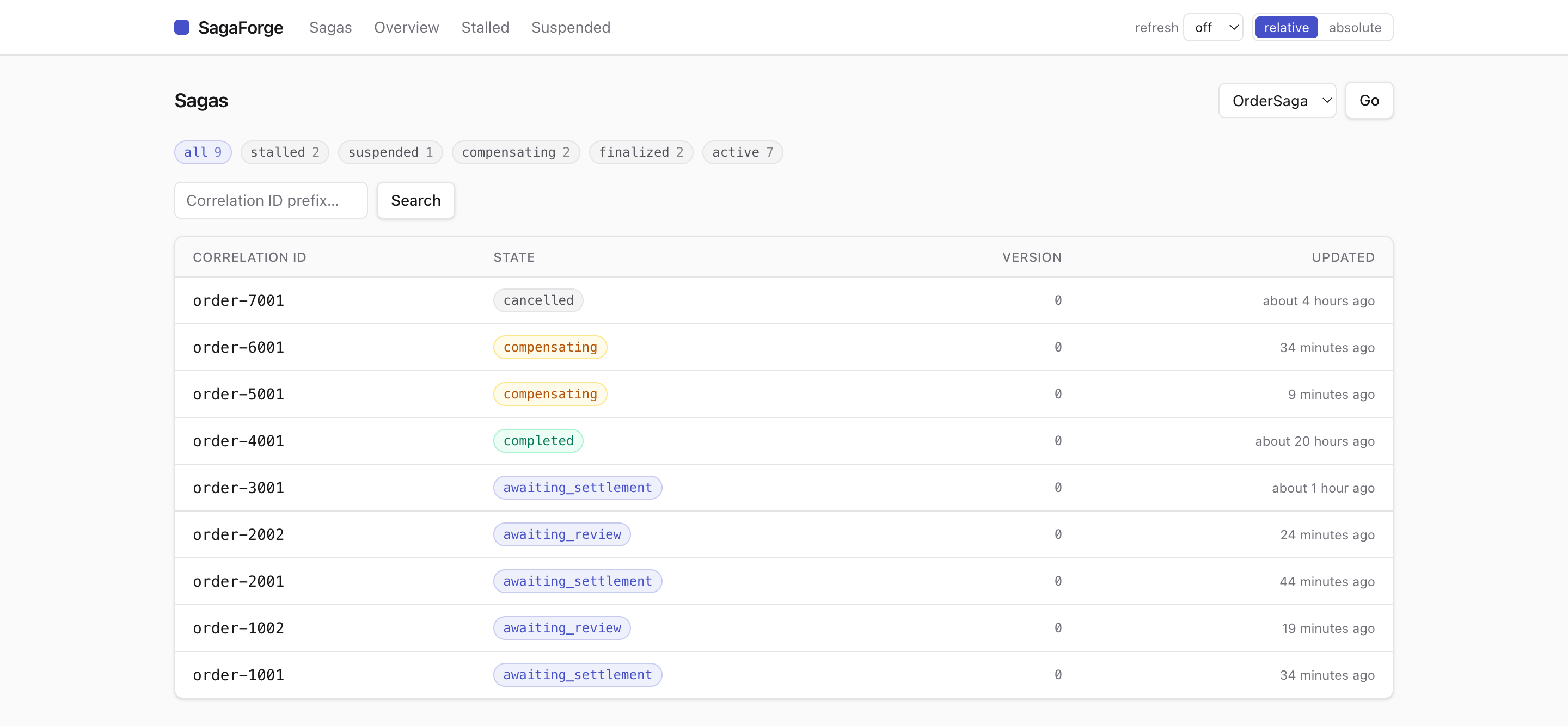
- A management dashboard. Fleet overview, the per-saga event ledger, a parsed state-machine graph, and one-click resume/compensate/cancel. See the tour →
- Multi-database support. One flag at install puts SagaForge's tables in their own database.
SagaForge or ChronoForge?
They are siblings. If the workflow mostly waits for the outside world and needs an unwind story, it is a saga. If it is a sequence of steps your own code drives and should survive crashes and retries, it is a ChronoForge workflow. They compose: a saga step that needs resumable sub-steps kicks off a ChronoForge workflow and parks on its completion event.
Documentation
- Guide & APIgithub.com/radioactive-labs/saga_forge
- Dashboardscreenshot tour
- Dashboard gemsaga_forge-dashboard
- Gemrubygems.org/gems/saga_forge
- SiblingChronoForge, durable workflows for Rails